Octopus Drawing Made Simple: Curling Tentacles and Realistic Shading for New Artists
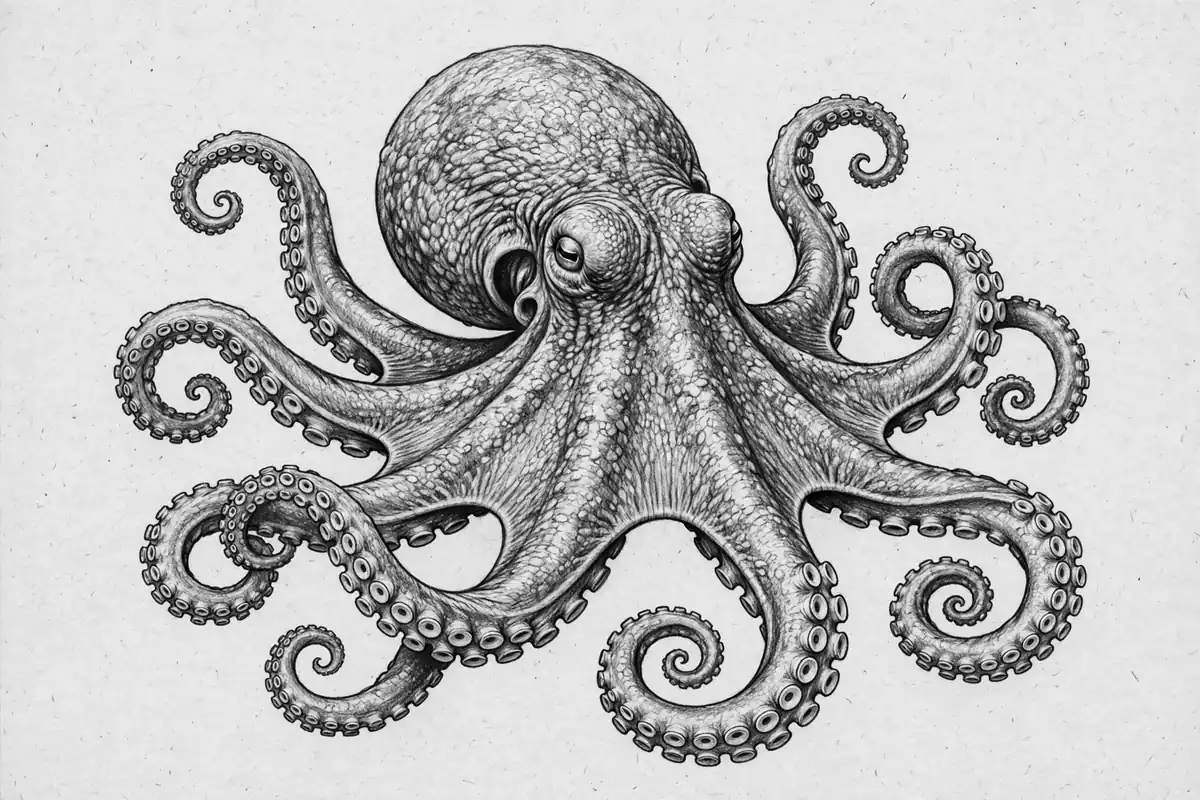
An octopus drawing looks complicated because of its eight curling arms, but the animal is soft and forgiving. There are no straight bones and no exact proportions. If a tentacle bends differently than planned, it still looks natural.
We start with one round head shape, add the arms as flowing ribbons, and save suckers and shading for last. Keep early lines pale and let the drawing darken slowly.
What You Need
- HB pencil — for the pale outline that erases easily.
- 2B pencil — for firmer lines and light shading.
- 4B pencil — for shadowed tentacle undersides.
- 6B pencil — for the darkest creases and eyes.
- Kneaded eraser — lifts soft highlights off the head.
- Regular eraser — for cleaning up guide lines.
- Sharpener — sucker details need a fine point.
- Smooth drawing paper — lets graphite layer evenly.
- Blending stump or tissue — softens shading on the head.
- A reference photo — for checking how tentacles taper.
How to Draw an Octopus Step by Step
Step 1: Place the head as a soft round shape
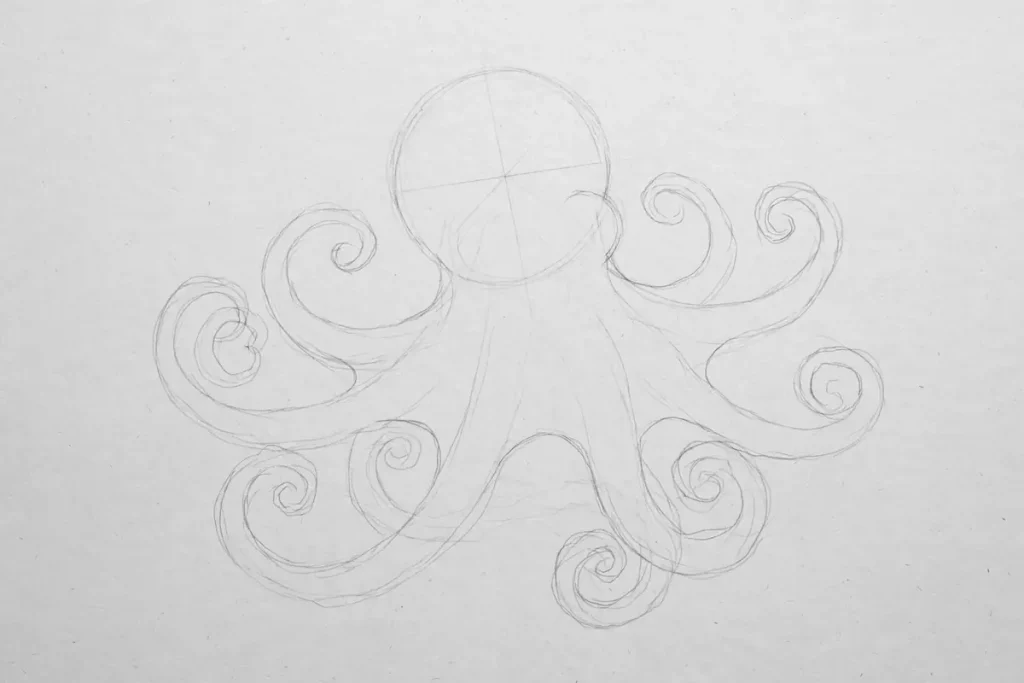
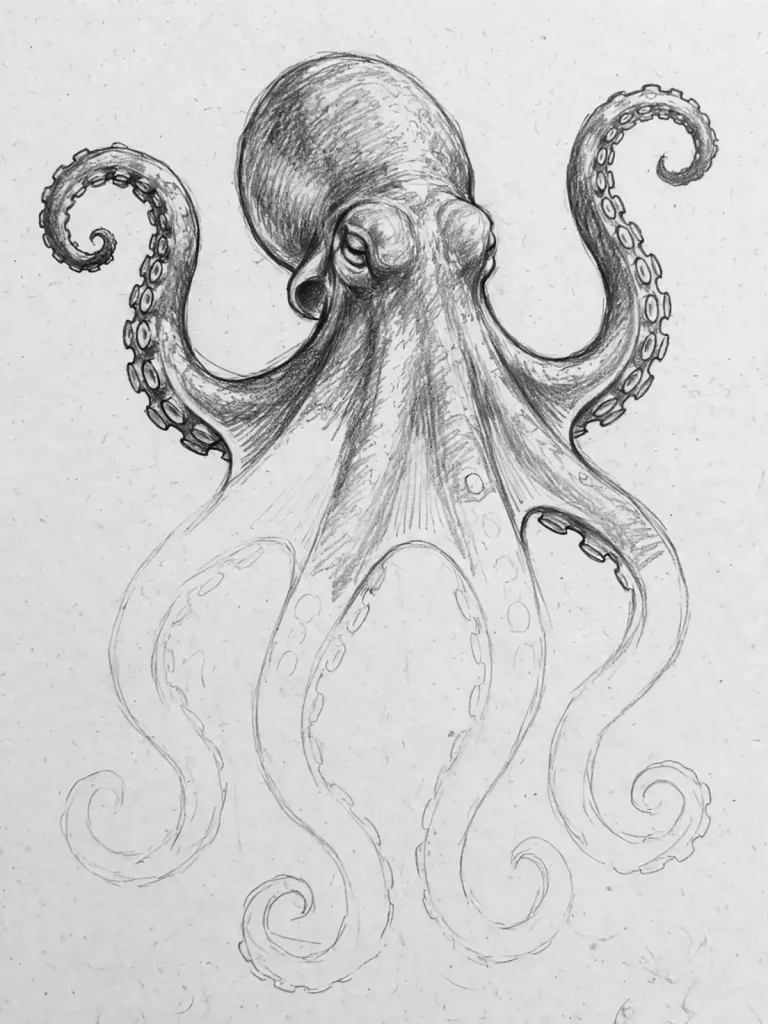
Near the top middle of the page, draw a loose oval with your HB pencil, slightly taller than wide. This is the mantle, the rounded head. Leave half the page empty below it — the tentacles need more room than beginners expect.
Step 2: Flow the first four tentacles downward
From under the head, draw four long, curving ribbon shapes spreading down and outward, thick at the body and thinner toward the tips. Let the outer two sweep wide and the inner two drop steeply, like slow movement underwater.
Step 3: Add the back tentacles and the curls
Tuck four more tentacles behind and between the first ones, slightly thinner so they read as farther away. Curl a few tips into loose spirals, like ribbon settling on a table. Count the arms now — eight in total.
Step 4: Set the eyes and clean the outline
Octopus eyes sit low on the head, where the mantle meets the arms. Sketch each as a small horizontal oval with a heavy lid above it. Once they sit level, firm up your good lines with the 2B and erase the rest.
Step 5: Mark the sucker rows in pencil first
Along the underside of each tentacle, lightly mark two rows of small circles, bigger near the body and shrinking toward every tip. Do not shade yet. Steadily shrinking suckers are what make the arms read as real, tapering limbs.
Step 6: Shade the head in one smooth layer
With the 2B, shade the mantle in one even layer, following its roundness with curved strokes. Keep the top lighter and the sides a touch darker, then blend gently. The head is smooth skin, so this layer should look calm, not scratchy.
Step 7: Give every tentacle a shaded underside
Switch to the 4B and shade the underside and outer edge of each tentacle, leaving the upper surface lighter. Where one arm passes behind another, darken the gap. That small shadow keeps the tangle readable instead of one grey knot.
Step 8: Finish the suckers one arm at a time
Work through one tentacle at a time, darkening each sucker as a small ring with a soft center, using the sharp 4B point. Keep rings round underneath and squashed where the arm curves away. Rushing here flattens everything, so go slowly.
Step 9: Add the bumpy skin texture
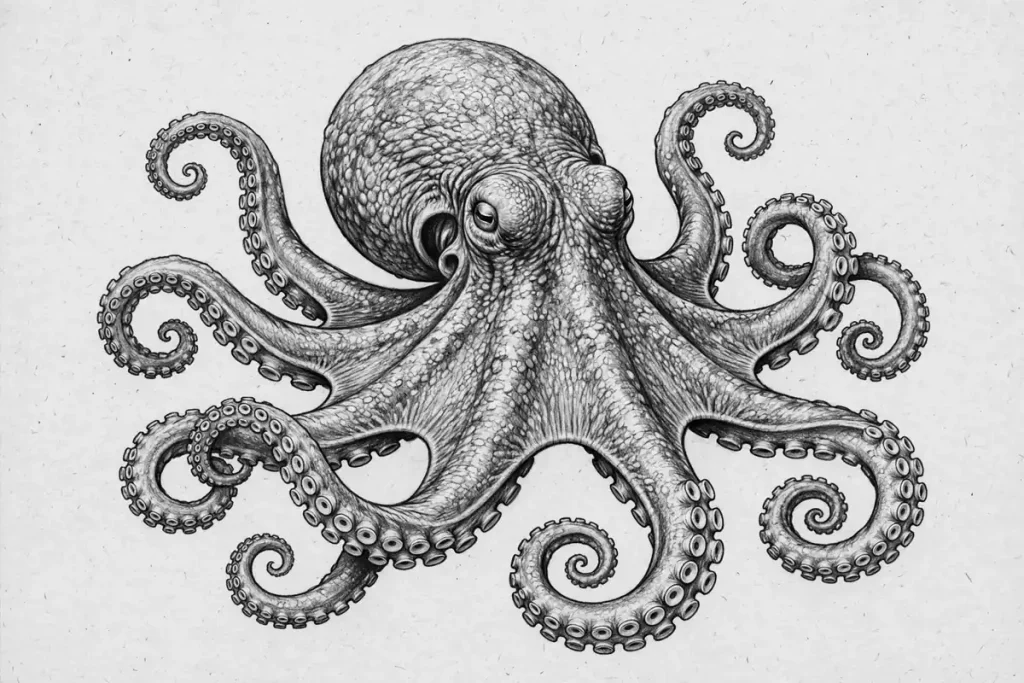
Real octopus skin is not perfectly smooth. Add short, broken strokes and tiny bumps over the head and arms with the 2B, denser where skin folds near the eyes. Keep marks varied — identical bumps look like scales, which belong to another animal.
Step 10: Deepen the darkest points and lift highlights
Finish with the 6B in a few places only: inside the eye, under the head, and where tentacles overlap. Dab the kneaded eraser along the mantle top for a wet-looking shine. Step back and check the arms still read as eight.
Common Mistakes to Avoid
- Drawing all eight tentacles the same. Identical arms look like a cartoon sun. Vary curls, lengths, and directions.
- Making the suckers all one size. Real suckers shrink toward the tip. Uniform circles flatten the tentacle.
- Shading the head too dark, too early. Keep the mantle the lightest large area, or your deepest shadows have nowhere to go.
Try this octopus again and change one thing — raise two arms higher, or curl every tip tighter. The second version almost always looks braver than the first.